


In this weekly column Kansas Pregame publisher John Baetz will take us on a journey across the state as he explores a wide variety of topics focused on Kansas high school football.
To Spread or not to Spread? That is the question.
Offensive football philosophy appears to have shifted dramatically since the 90s as Kansas high school football coaches across the state employ more shotgun multiple receiver - or Spread - sets, but while it may give the illusion of a paradigm shift, really the more things change the more they stay the same.
In week one I watched a quarter and a half of the rivalry game between Beloit and Concordia and the Saturday after Thanksgiving I traveled to Salina and watched the 4A championship featuring Rose Hill and Eudora. These two games illustrate my point perfectly.
The offensive football in these two games was schematically on opposite ends of the spectrum, but in reality all four of the teams involved just use different formations to run the option. While blocking schemes, and player alignment may differ significantly ground pounding was still the preferred method of pigskin transportation.
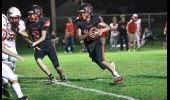
Beloit runs the Double Wing under head coach Greg Koenig. The formation involves packing all 11 of your players in the center of the field and then handing it off to one of three backs or having the quarterback keep. Koenig's Double Wing is one of the tightest formations you will see in all of high school football with foot-to-foot splits, wingbacks off the hip of each tight end, and a single back behind the quarterback.
Concordia runs primarily the Wishbone under head coach Tim Lambert although Lambert added a Flexbone look to his system with the move to Concordia which utilizes a pair of wingbacks similar to Koenig's Double Wing but with wider line splits and the occasional split receiver stretching the defense to the sideline. Lambert is a Smith Center native who quarterbacked the Redmen to the state championship in 1986 and utilizes the same Smith Center Wishbone that he did for nearly 15 years as the head coach at St. Francis.
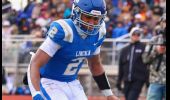
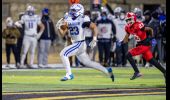
The Rose Hill Rockets under Greg Slade run what is most commonly referred to as the Spread which refers to the multiple receivers that are used to spread the defense across the field. With Derrick Decker in the shotgun and backs Johnny Pearson and Eastin Dockers aligning in multiple locations on the field the Rockets kept the best defenses in the state of Kansas guessing with their zone read and short to intermediate passing game.
Eudora in their first ever state championship under head coach Gregg Webb ran a hybrid offense that featured components of Webb's vaunted Power I attack which was used to win tons of games at Claflin and an interesting version of the Wildcat that often saw 5'7" Chris Pyle take the direct snap. Throw in the occasional jet sweep with Pyle and Webb's multiple offense was fascinating, but was hampered by turnovers and Rose Hill's swarming defense.
The Beloit/Concordia game was probably the best illustration of "traditional" option football that I saw all year with two big offensive lines just banging heads and multiple backs getting a chance to run the ball and seldom a pass lofted in the air. For several decades this was the way football was played in the heartland, three yards and a cloud of dust.
The late 90s and 2000s saw college programs across the country scrap traditional option football for the modern spread attack and a number of Kansas high schools, including 4A state champion Rose Hill, utilize the Spread as their primary offensive package.
The primary difference in all these offenses isn't so much the action of the skill position players as all use some form of the option - the quarterback choosing who to hand off or pitch to on the run. The real difference is the line blocking.
Koenig's Double Wing employs a near constant pulling and downblocking scheme that features guards, tackles, tight ends and even centers pulling to kick out or hook blockers at the point of attack. The Trojan offense also adds a variety of misdirection double handoff plays sometimes using both wingbacks to handoff the ball and of course there's the simple dive to the fullback, toss sweep and quarterback sweep. But the key is the play of the Beloit offensive line which was HUGE this year, but also played quick, low and physical which is all the more necessary in a pulling/trapping scheme.
Lambert's Wishbone features a man-blocking scheme that generally attacks three areas, the A gap between center and guard, the C gap off tackle (or between tackle and tight end) and the D gap to the sideline. The footwork of the linemen is specific to opening up those holes and while many Wishbone schemes often allow the quarterback to attack the end and choose to keep or pitch, the goal of Lambert's Wishbone is to primarily establish the inside run then, very rarely, allow the quarterback to keep around edge or run the backfield on a counter or trap back against the grain. The footwork of the line and the action of the backfield are complementary setting each other up for success, but the key is the line's ability to open up the primary running lane.
For Slade and the Rose Hill Rockets there are two essential components to offensive success. The first is the play of the offensive line which often utilizes a zone blocking scheme. Rather than trying to open up a specific hole like the two previously mentioned offenses, the Spread relies on the offensive linemen taking what the defense gives them and working to overtake or drive a defender based on the play call, defensive alignment and reaction of the defense to the initial play action. In essence the line is blocking an area - or zone - rather than a man.
Slade's offensive line was not huge, but they were quick and physical and understood their responsibilities, but perhaps more important was the play of his talented quarterback Derrick Decker who knew how to read the backside away from the line's zone step and had an excellent sense of when to handoff or pitch (see his last second pitch in the first round playoff win over Holton as an example) to one of a stable of talented backs including Johnny Pearson or Eastin Dockers.
Decker also has a nice arm with great accuracy and the Rockets potent run game often left opposing defenses struggling to defend the multiple receivers attacking with a wide array of routes. Decker showed his accuracy on the opening score of the state title game hitting Caleb Braddy on an over the top touchdown pass right down the middle, and credit Braddy for going up to get it before it was blown out of Salina Stadium by 40 the mph wind.
Eudora's offense was probably the most unique of the four teams featured here, but still the line and the run game were the key components. Speedy Chris Pyle was utilized in a number of formations including as a slot receiver often running the jet sweep to take the ball off the edge and receiving the direct shotgun snap in a formation very similar to K-State's Wildcat formation that utilizes running back Angelo Pease on the quarterback power. Quarterback Derek Webb and big running back Gabe Cleveland were talented players and the Eudora line was disciplined and physical, but the smaller more athletic Rose Hill defense was impressive running to the ball. The game was much closer than the 21-0 score indicated and turnovers were a huge factor in the final outcome, but I think Rose Hill left no doubt they are the best team in 4A after their impressive late season run.
And while us media types often like to focus on offense, defense wins championships and it certainly was key in both of the games here. Rose Hill's defense was one of the fastest and best coached defenses I saw play all year while Beloit and Concordia both played excellent defense in their season opener, Beloit just gave up a big play late in the game that essentially was the difference.
But more about defense in a future P.O.T.P.




Use your Facebook account to add a comment or start a discussion. Posts are subject to Facebook's Terms of Service and Privacy Policy. Your Facebook name, photo & other personal information you make public on Facebook will appear with your comment.


